I am trying to write a .sh file that runs many programs simultaneously
I tried this
prog1 prog2 But that runs prog1 then waits until prog1 ends and then starts prog2...
So how can I run them in parallel?
016 Answers
How about:
prog1 & prog2 && fg This will:
- Start
prog1. - Send it to background, but keep printing its output.
- Start
prog2, and keep it in foreground, so you can close it withctrl-c. - When you close
prog2, you'll return toprog1's foreground, so you can also close it withctrl-c.
To run multiple programs in parallel:
prog1 & prog2 & If you need your script to wait for the programs to finish, you can add:
wait at the point where you want the script to wait for them.
9If you want to be able to easily run and kill multiple process with ctrl-c, this is my favorite method: spawn multiple background processes in a (…) subshell, and trap SIGINT to execute kill 0, which will kill everything spawned in the subshell group:
(trap 'kill 0' SIGINT; prog1 & prog2 & prog3) You can have complex process execution structures, and everything will close with a single ctrl-c (just make sure the last process is run in the foreground, i.e., don't include a & after prog1.3):
(trap 'kill 0' SIGINT; prog1.1 && prog1.2 & (prog2.1 | prog2.2 || prog2.3) & prog1.3) You can use wait:
some_command & P1=$! other_command & P2=$! wait $P1 $P2 It assigns the background program PIDs to variables ($! is the last launched process' PID), then the wait command waits for them. It is nice because if you kill the script, it kills the processes too!
With GNU Parallel it is as easy as:
(echo prog1; echo prog2) | parallel Or if you prefer:
parallel ::: prog1 prog2 Learn more:
- Watch the intro video for a quick introduction:
- Walk through the tutorial (man parallel_tutorial). Your command line will love you for it.
- Read: Ole Tange, GNU Parallel 2018 (Ole Tange, 2018).
xargs -P <n> allows you to run <n> commands in parallel.
While -P is a nonstandard option, both the GNU (Linux) and macOS/BSD implementations support it.
The following example:
- runs at most 3 commands in parallel at a time,
- with additional commands starting only when a previously launched process terminates.
time xargs -P 3 -I {} sh -c 'eval "$1"' - {} <<'EOF' sleep 1; echo 1 sleep 2; echo 2 sleep 3; echo 3 echo 4 EOF The output looks something like:
1 # output from 1st command 4 # output from *last* command, which started as soon as the count dropped below 3 2 # output from 2nd command 3 # output from 3rd command real 0m3.012s user 0m0.011s sys 0m0.008s The timing shows that the commands were run in parallel (the last command was launched only after the first of the original 3 terminated, but executed very quickly).
The xargs command itself won't return until all commands have finished, but you can execute it in the background by terminating it with control operator & and then using the wait builtin to wait for the entire xargs command to finish.
{ xargs -P 3 -I {} sh -c 'eval "$1"' - {} <<'EOF' sleep 1; echo 1 sleep 2; echo 2 sleep 3; echo 3 echo 4 EOF } & # Script execution continues here while `xargs` is running # in the background. echo "Waiting for commands to finish..." # Wait for `xargs` to finish, via special variable $!, which contains # the PID of the most recently started background process. wait $! Note:
BSD/macOS
xargsrequires you to specify the count of commands to run in parallel explicitly, whereas GNUxargsallows you to specify-P 0to run as many as possible in parallel.Output from the processes run in parallel arrives as it is being generated, so it will be unpredictably interleaved.
- GNU
parallel, as mentioned in Ole's answer (does not come standard with most platforms), conveniently serializes (groups) the output on a per-process basis and offers many more advanced features.
- GNU
#!/bin/bash prog1 & 2> .errorprog1.log; prog2 & 2> .errorprog2.log Redirect errors to separate logs.
3Here is a function I use in order to run at max n process in parallel (n=4 in the example):
max_children=4 function parallel { local time1=$(date +"%H:%M:%S") local time2="" # for the sake of the example, I'm using $2 as a description, you may be interested in other description echo "starting $2 ($time1)..." "$@" && time2=$(date +"%H:%M:%S") && echo "finishing $2 ($time1 -- $time2)..." & local my_pid=$$ local children=$(ps -eo ppid | grep -w $my_pid | wc -w) children=$((children-1)) if [[ $children -ge $max_children ]]; then wait -n fi } parallel sleep 5 parallel sleep 6 parallel sleep 7 parallel sleep 8 parallel sleep 9 wait If max_children is set to the number of cores, this function will try to avoid idle cores.
4There is a very useful program that calls nohup.
nohup - run a command immune to hangups, with output to a non-tty I had a similar situation recently where I needed to run multiple programs at the same time, redirect their outputs to separated log files and wait for them to finish and I ended up with something like that:
#!/bin/bash # Add the full path processes to run to the array PROCESSES_TO_RUN=("/home/joao/Code/test/prog_1/prog1" \ "/home/joao/Code/test/prog_2/prog2") # You can keep adding processes to the array... for i in ${PROCESSES_TO_RUN[@]}; do ${i%/*}/./${i##*/} > ${i}.log 2>&1 & # ${i%/*} -> Get folder name until the / # ${i##*/} -> Get the filename after the / done # Wait for the processes to finish wait You can try ppss (abandoned). ppss is rather powerful - you can even create a mini-cluster. xargs -P can also be useful if you've got a batch of embarrassingly parallel processing to do.
This works beautifully for me (found here):
sh -c 'command1 & command2 & command3 & wait' It outputs all the logs of each command intermingled (which is what I wanted), and all are killed with ctrl+c.
1Process Spawning Manager
Sure, technically these are processes, and this program should really be called a process spawning manager, but this is only due to the way that BASH works when it forks using the ampersand, it uses the fork() or perhaps clone() system call which clones into a separate memory space, rather than something like pthread_create() which would share memory. If BASH supported the latter, each "sequence of execution" would operate just the same and could be termed to be traditional threads whilst gaining a more efficient memory footprint. Functionally however it works the same, though a bit more difficult since GLOBAL variables are not available in each worker clone hence the use of the inter-process communication file and the rudimentary flock semaphore to manage critical sections. Forking from BASH of course is the basic answer here but I feel as if people know that but are really looking to manage what is spawned rather than just fork it and forget it. This demonstrates a way to manage up to 200 instances of forked processes all accessing a single resource. Clearly this is overkill but I enjoyed writing it so I kept on. Increase the size of your terminal accordingly. I hope you find this useful.
ME=$(basename $0) IPC="/tmp/$ME.ipc" #interprocess communication file (global thread accounting stats) DBG=/tmp/$ME.log echo 0 > $IPC #initalize counter F1=thread SPAWNED=0 COMPLETE=0 SPAWN=1000 #number of jobs to process SPEEDFACTOR=1 #dynamically compensates for execution time THREADLIMIT=50 #maximum concurrent threads TPS=1 #threads per second delay THREADCOUNT=0 #number of running threads SCALE="scale=5" #controls bc's precision START=$(date +%s) #whence we began MAXTHREADDUR=6 #maximum thread life span - demo mode LOWER=$[$THREADLIMIT*100*90/10000] #90% worker utilization threshold UPPER=$[$THREADLIMIT*100*95/10000] #95% worker utilization threshold DELTA=10 #initial percent speed change threadspeed() #dynamically adjust spawn rate based on worker utilization { #vaguely assumes thread execution average will be consistent THREADCOUNT=$(threadcount) if [ $THREADCOUNT -ge $LOWER ] && [ $THREADCOUNT -le $UPPER ] ;then echo SPEED HOLD >> $DBG return elif [ $THREADCOUNT -lt $LOWER ] ;then #if maxthread is free speed up SPEEDFACTOR=$(echo "$SCALE;$SPEEDFACTOR*(1-($DELTA/100))"|bc) echo SPEED UP $DELTA%>> $DBG elif [ $THREADCOUNT -gt $UPPER ];then #if maxthread is active then slow down SPEEDFACTOR=$(echo "$SCALE;$SPEEDFACTOR*(1+($DELTA/100))"|bc) DELTA=1 #begin fine grain control echo SLOW DOWN $DELTA%>> $DBG fi echo SPEEDFACTOR $SPEEDFACTOR >> $DBG #average thread duration (total elapsed time / number of threads completed) #if threads completed is zero (less than 100), default to maxdelay/2 maxthreads COMPLETE=$(cat $IPC) if [ -z $COMPLETE ];then echo BAD IPC READ ============================================== >> $DBG return fi #echo Threads COMPLETE $COMPLETE >> $DBG if [ $COMPLETE -lt 100 ];then AVGTHREAD=$(echo "$SCALE;$MAXTHREADDUR/2"|bc) else ELAPSED=$[$(date +%s)-$START] #echo Elapsed Time $ELAPSED >> $DBG AVGTHREAD=$(echo "$SCALE;$ELAPSED/$COMPLETE*$THREADLIMIT"|bc) fi echo AVGTHREAD Duration is $AVGTHREAD >> $DBG #calculate timing to achieve spawning each workers fast enough # to utilize threadlimit - average time it takes to complete one thread / max number of threads TPS=$(echo "$SCALE;($AVGTHREAD/$THREADLIMIT)*$SPEEDFACTOR"|bc) #TPS=$(echo "$SCALE;$AVGTHREAD/$THREADLIMIT"|bc) # maintains pretty good #echo TPS $TPS >> $DBG } function plot() { echo -en \\033[${2}\;${1}H if [ -n "$3" ];then if [[ $4 = "good" ]];then echo -en "\\033[1;32m" elif [[ $4 = "warn" ]];then echo -en "\\033[1;33m" elif [[ $4 = "fail" ]];then echo -en "\\033[1;31m" elif [[ $4 = "crit" ]];then echo -en "\\033[1;31;4m" fi fi echo -n "$3" echo -en "\\033[0;39m" } trackthread() #displays thread status { WORKERID=$1 THREADID=$2 ACTION=$3 #setactive | setfree | update AGE=$4 TS=$(date +%s) COL=$[(($WORKERID-1)/50)*40] ROW=$[(($WORKERID-1)%50)+1] case $ACTION in "setactive" ) touch /tmp/$ME.$F1$WORKERID #redundant - see main loop #echo created file $ME.$F1$WORKERID >> $DBG plot $COL $ROW "Worker$WORKERID: ACTIVE-TID:$THREADID INIT " good ;; "update" ) plot $COL $ROW "Worker$WORKERID: ACTIVE-TID:$THREADID AGE:$AGE" warn ;; "setfree" ) plot $COL $ROW "Worker$WORKERID: FREE " fail rm /tmp/$ME.$F1$WORKERID ;; * ) ;; esac } getfreeworkerid() { for i in $(seq 1 $[$THREADLIMIT+1]) do if [ ! -e /tmp/$ME.$F1$i ];then #echo "getfreeworkerid returned $i" >> $DBG break fi done if [ $i -eq $[$THREADLIMIT+1] ];then #echo "no free threads" >> $DBG echo 0 #exit else echo $i fi } updateIPC() { COMPLETE=$(cat $IPC) #read IPC COMPLETE=$[$COMPLETE+1] #increment IPC echo $COMPLETE > $IPC #write back to IPC } worker() { WORKERID=$1 THREADID=$2 #echo "new worker WORKERID:$WORKERID THREADID:$THREADID" >> $DBG #accessing common terminal requires critical blocking section (flock -x -w 10 201 trackthread $WORKERID $THREADID setactive )201>/tmp/$ME.lock let "RND = $RANDOM % $MAXTHREADDUR +1" for s in $(seq 1 $RND) #simulate random lifespan do sleep 1; (flock -x -w 10 201 trackthread $WORKERID $THREADID update $s )201>/tmp/$ME.lock done (flock -x -w 10 201 trackthread $WORKERID $THREADID setfree )201>/tmp/$ME.lock (flock -x -w 10 201 updateIPC )201>/tmp/$ME.lock } threadcount() { TC=$(ls /tmp/$ME.$F1* 2> /dev/null | wc -l) #echo threadcount is $TC >> $DBG THREADCOUNT=$TC echo $TC } status() { #summary status line COMPLETE=$(cat $IPC) plot 1 $[$THREADLIMIT+2] "WORKERS $(threadcount)/$THREADLIMIT SPAWNED $SPAWNED/$SPAWN COMPLETE $COMPLETE/$SPAWN SF=$SPEEDFACTOR TIMING=$TPS" echo -en '\033[K' #clear to end of line } function main() { while [ $SPAWNED -lt $SPAWN ] do while [ $(threadcount) -lt $THREADLIMIT ] && [ $SPAWNED -lt $SPAWN ] do WID=$(getfreeworkerid) worker $WID $SPAWNED & touch /tmp/$ME.$F1$WID #if this loops faster than file creation in the worker thread it steps on itself, thread tracking is best in main loop SPAWNED=$[$SPAWNED+1] (flock -x -w 10 201 status )201>/tmp/$ME.lock sleep $TPS if ((! $[$SPAWNED%100]));then #rethink thread timing every 100 threads threadspeed fi done sleep $TPS done while [ "$(threadcount)" -gt 0 ] do (flock -x -w 10 201 status )201>/tmp/$ME.lock sleep 1; done status } clear threadspeed main wait status echo Your script should look like:
prog1 & prog2 & . . progn & wait progn+1 & progn+2 & . . Assuming your system can take n jobs at a time. use wait to run only n jobs at a time.
With bashj ( ) , you should be able to run not only multiple processes (the way others suggested) but also multiple Threads in one JVM controlled from your script. But of course this requires a java JDK. Threads consume less resource than processes.
Here is a working code:
#!/usr/bin/bashj #!java public static int cnt=0; private static void loop() {u.p("java says cnt= "+(cnt++));u.sleep(1.0);} public static void startThread() {(new Thread(() -> {while (true) {loop();}})).start();} #!bashj j.startThread() while [ j.cnt -lt 4 ] do echo "bash views cnt=" j.cnt sleep 0.5 done If you're:
- On Mac and have iTerm
- Want to start various processes that stay open long-term / until Ctrl+C
- Want to be able to easily see the output from each process
- Want to be able to easily stop a specific process with Ctrl+C
One option is scripting the terminal itself if your use case is more app monitoring / management.
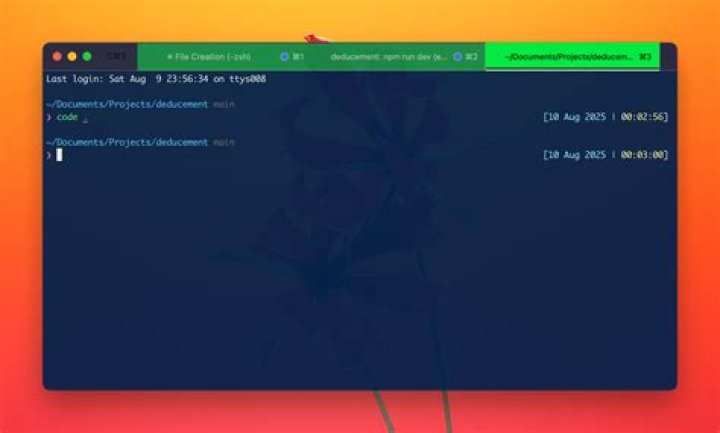
For example I recently did the following. Granted it's Mac specific, iTerm specific, and relies on a deprecated Apple Script API (iTerm has a newer Python option). It doesn't win any elegance awards but gets the job done.
#!/bin/sh root_path="~/root-path" auth_api_script="$root_path/auth-path/auth-script.sh" admin_api_proj="$root_path/admin-path/admin.csproj" agent_proj="$root_path/agent-path/agent.csproj" dashboard_path="$root_path/dashboard-web" osascript <<THEEND tell application "iTerm" set newWindow to (create window with default profile) tell current session of newWindow set name to "Auth API" write text "pushd $root_path && $auth_api_script" end tell tell newWindow set newTab to (create tab with default profile) tell current session of newTab set name to "Admin API" write text "dotnet run --debug -p $admin_api_proj" end tell end tell tell newWindow set newTab to (create tab with default profile) tell current session of newTab set name to "Agent" write text "dotnet run --debug -p $agent_proj" end tell end tell tell newWindow set newTab to (create tab with default profile) tell current session of newTab set name to "Dashboard" write text "pushd $dashboard_path; ng serve -o" end tell end tell end tell THEEND